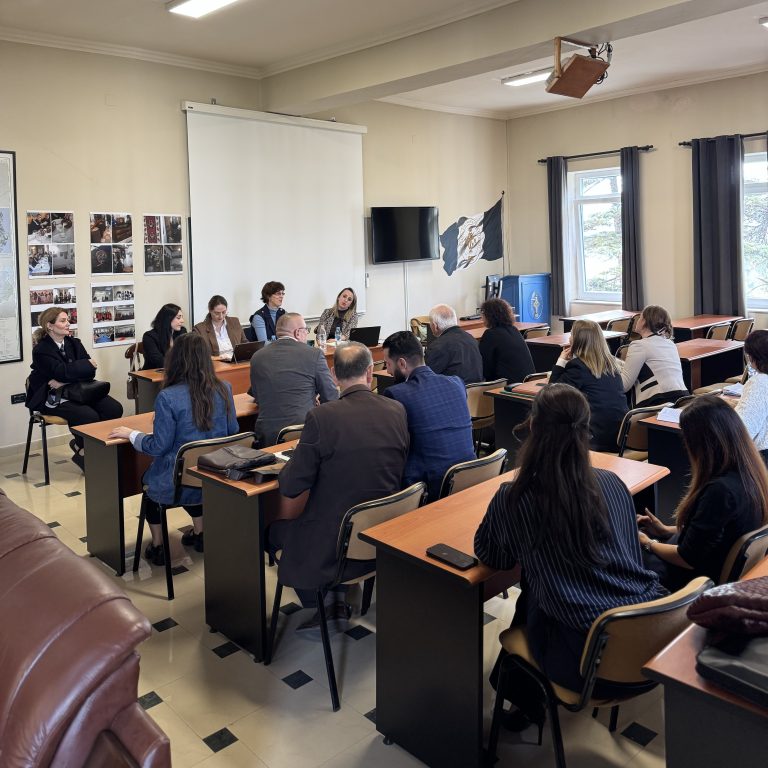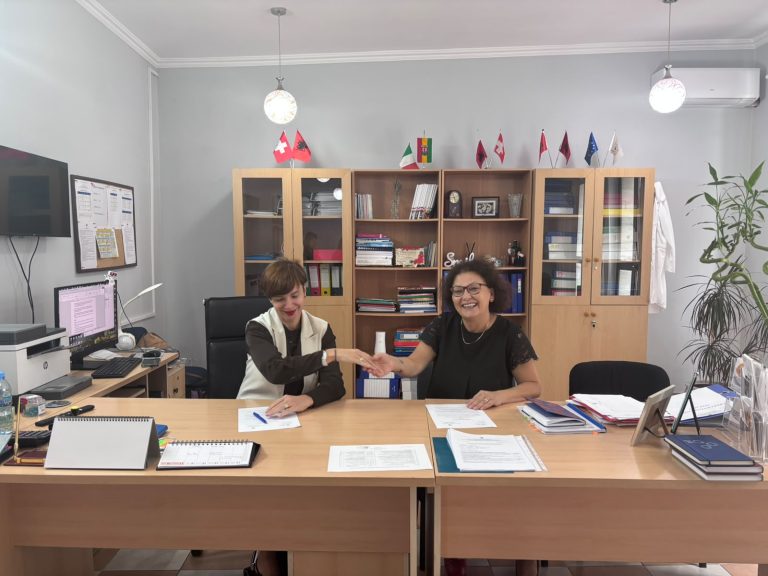

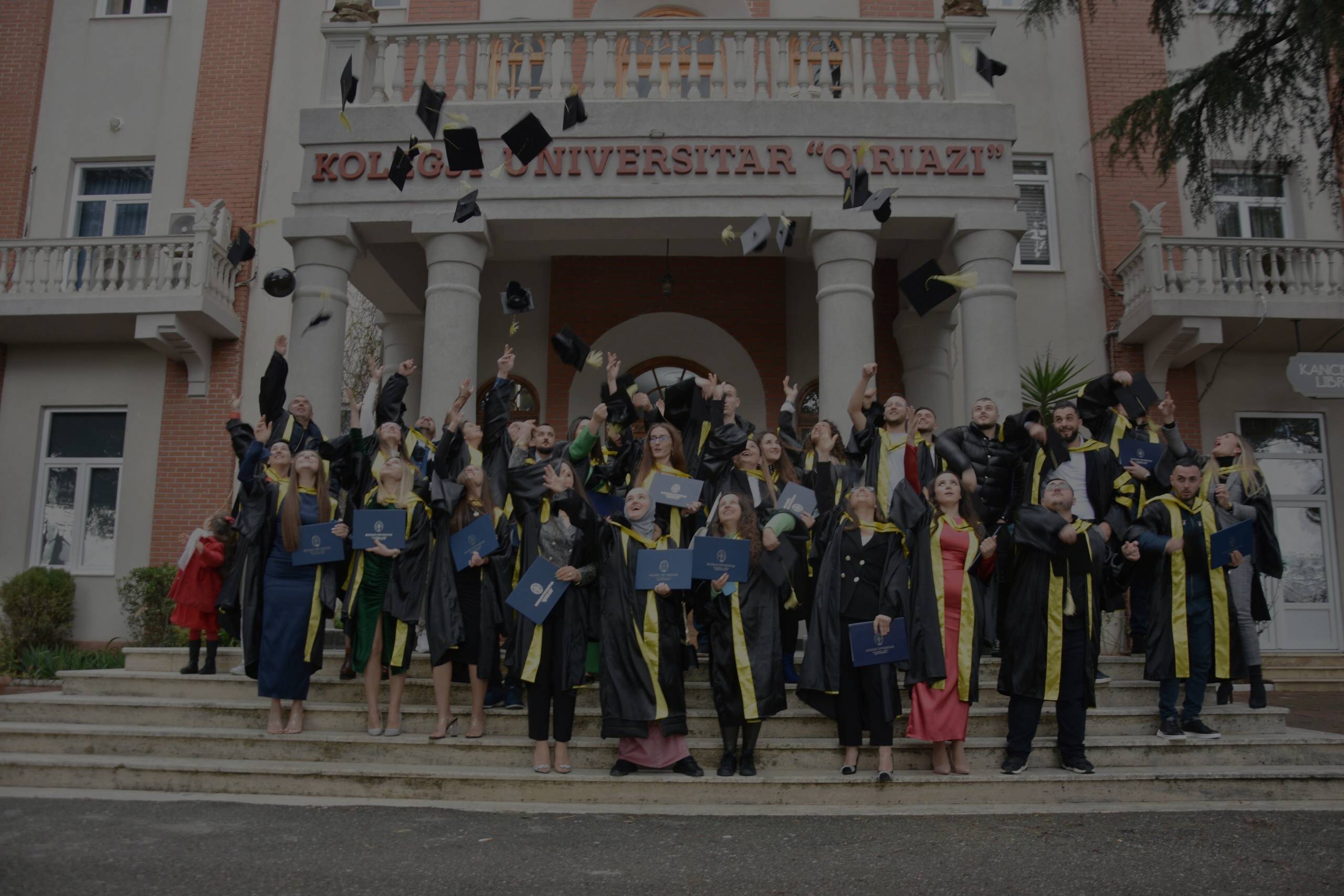

On 29 May 2026, Qiriazi University College hosted and organized Sessions 26 and 27 of the 21st International and Interdisciplinary Conference of the Albanian Institute of Sociology (AIS), entitled “Towards an Intelligent Society: Challenges & Opportunities.” The event was organized in cooperation with the Albanian Institute of Sociology (AIS), “Fehmi Agani” University of Gjakova, and other academic partners, bringing together researchers, lecturers, students, and scholars from Albania, Kosovo, and other countries. Three third-year students from the Faculty of Law, Visarda Dunga, Brunilda Lama, and Melisa Gjoka, participated as presenters at this conference, together with their lecturer, Dr. Valbona Nathanaili. They presented their research paper entitled “Women’s Right to Property and Inheritance in Albania: The Challenge Between Legislation and Social Reality,” representing Qiriazi University College.
WOMEN’S RIGHT TO PROPERTY AND INHERITANCE IN ALBANIA
The challenge between legislation and social reality
- Visarda DUNGA, Student, Faculty of Law, Qiriazi University College, Tirana, Albania
- Brunilda LAMA, Student, Faculty of Law, Qiriazi University College, Tirana, Albania
- Melisa GJOKA, Student, Faculty of Law, Qiriazi University College, Tirana, Albania
- Dr. Valbona NATHANAILI, Lecturer, Qiriazi University College, Tirana, Albania
Abstract
This study adopts a socio-legal approach to examine the relationship between formal legal provisions (de jure) and their implementation in practice (de facto) concerning women’s property and inheritance rights in Albania. While the legal framework, comprising the Civil Code, the Family Code, and constitutional guarantees, formally ensures gender equality, the extent to which these rights are reflected in judicial practice remains an open question. The research combines normative legal analysis with an empirical examination of case law from the High Court of Albania. Although the broader study is designed to cover the period 2014-2018, this paper presents preliminary findings based on decisions issued in 2015. Out of 521 civil decisions reviewed, only four cases (approximately 0.8%) involve women bringing claims to assert their property and inheritance rights. The analysed cases concern disputes over inheritance and family property relations, in which women act as claimants seeking recognition or recovery of their rights through judicial mechanisms. The findings show that the realization of these rights often requires formal legal action, including inheritance division, recovery claims, or challenges to prior legal acts. While the limited number of cases does not allow for causal conclusions, it points to the relatively narrow empirical visibility of such claims within the analysed dataset and raises questions about the factors that shape access to judicial remedies. The paper contributes to ongoing discussions on the practical realization of gender equality in property rights.
Key Words: women rights, inheritance, youth perceptions, Albania, gender, norms
- INTRODUCTION
Inheritance rights in Albania and other developing contexts have been identified as among the most systematically denied rights for women, while simultaneously representing one of the primary pathways through which women with limited resources can acquire property (Kola, 2025, p. 50). However, women’s ability to claim these rights is often constrained by informal pressures, including stigma, family expectations, and limited access to legal knowledge and representation (Michael, 2025, p. 137). These constraints are closely linked to broader gender norms, which are socially constructed and transmitted through families, peer groups, and social institutions. Such norms are not only internalized by individuals but also actively reconstructed through everyday interactions, thereby shaping and reinforcing societal expectations. As a result, adherence to gender norms varies across individuals and contexts, while remaining embedded in power relations and continuously reproduced through interactions between men and women (Pulerwitz & Barker, 2008, p. 324-325).
Within this framework, women’s access to resources, particularly property rights, becomes a critical dimension of their agency and well-being. Empirical evidence demonstrates that women’s ability to earn income, access employment, own property, and participate in decision-making significantly enhances their overall well-being and social position (Sen, 2011, p. 213). Despite the formal recognition of women’s inheritance rights in legal frameworks, a gap persists between law and practice. The effective realization of these rights depends not only on legislation but also on the accessibility of justice systems. In this regard, ensuring financial access to justice, through measures such as waiving court fees and strengthening institutional support, is essential for enabling women to claim their rights in practice (Berg et al., 2010, p. 15).
- Dunga, V., Lama, B., Gjoka, M., & Nathanaili, V. (2026). Women’s right to property and inheritance in Albania: The challenge between legislation and social reality. In E. Sokoli Kutrolli (Ed.), Proceedings: Toward an intelligent society: Challenges & opportunities (pp. 233–239).